
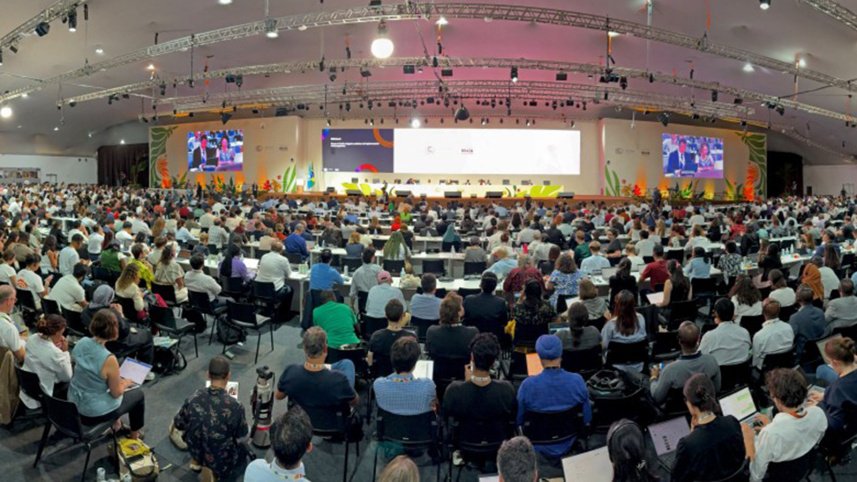


During the UN climate summit in the Brazilian Amazon, nations reached a modest agreement on Saturday, with many countries accepting weaker terms on phasing out fossil fuels to maintain unity.
After two weeks of intense negotiations on the outskirts of the rainforest, nearly 200 countries unanimously approved the deal, with the United States notably absent as President Donald Trump avoided the discussions.
The conclusion of the summit in steamy Belem was met with applause, marking the end of a dramatic event that witnessed protests, a damaging fire, and large street demonstrations.
Brazilian President Luiz Inacio Lula da Silva, who had heavily invested in the success of COP30, hailed the pact as a demonstration that a divided world could still come together in times of crisis.
“The international community had to make a choice: persevere or give up. We chose to persevere,” Lula stated while in South Africa for a G20 summit. “Multilateralism emerged victorious.”
Despite the victory, European ministers in Belem expressed subdued satisfaction, acknowledging that they accepted the diluted agreement to prevent the collapse of the entire process.
“We cannot ignore that we would have preferred a stronger outcome,” said EU climate chief Wopke Hoekstra.
He further noted, “Although somewhat abstract, there is significant value in collective action.”
China’s delegation leader at COP30, Li Gao, characterized the summit as a success achieved under challenging circumstances, highlighting the international community’s solidarity and joint efforts to combat climate change.
India, representing major emerging markets like Brazil, South Africa, and China, praised the deal as “meaningful.” Meanwhile, the Alliance of Small Island States, comprising 39 climate-vulnerable nations, described the agreement as “imperfect but essential progress” for a consensus-driven global body.
– Fossil fuels transition –
Prior to the talks, numerous countries had threatened to walk away if there was no clear strategy to phase out oil, gas, and coal. The finalized agreement referenced a previous commitment on fossil fuels without explicitly mentioning those specific terms.
COP30 President Andre Correa do Lago, acknowledging the desired ambition of some nations, proposed a voluntary “roadmap” away from fossil fuels as a consolation measure.
Colombian President Gustavo Petro rejected the deal, emphasizing his country’s upcoming summit on phasing out fossil fuels in April next year.
Although the roadmap concept gained momentum with early support from Lula, it faced expected opposition from major oil producers like Saudi Arabia, coal-rich India, and other stakeholders.
“President Lula’s call for roadmaps to end fossil fuels and deforestation set a high standard, but a divided global landscape hindered its realization,” remarked Carolina Pasquali of Greenpeace Brazil.
– Financial and trade aspects –
Brazil had managed expectations due to geopolitical challenges and the stance of the United States. Nevertheless, there was optimism that Brazil, advocating for developing nations and home to the largest rainforest, could achieve significant outcomes.
In a win for developing nations, the world agreed to triple financial support by 2035 for poorer countries to tackle climate change.
However, this was viewed as the minimum requirement, with a Bangladeshi negotiator affirming that the battle for more support would persist.
Nepalese negotiator Raju Pandit expressed disappointment, stating that the summit did not meet the expectations of climate-vulnerable countries.
Notably, the inclusion of robust language on trade measures in a COP agreement for the first time was considered a victory for China.
– COP in the Amazon –
Amid the political discourse, the summit differed notably from previous COPs held in authoritarian petrostates, with a more open and vibrant atmosphere.
Tens of thousands participated in lively street demonstrations, while protesters inside the venue made their voices heard.
However, the event also faced unexpected challenges, including a significant fire that broke out inside the venue and clashes between Indigenous protesters and security forces in the initial days.
The influence of the Amazon was evident throughout the summit, with the weather conditions and surroundings making a lasting impact on the proceedings.
Even during the final plenary session, a tired Correa do Lago struggled to speak above the noise of the Amazon rain, emphasizing the unique setting of the summit.