
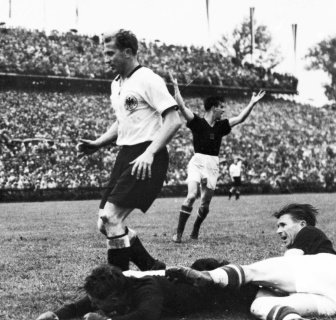


In the early 1950s, Hungary’s football team, known as the “Magic Magyars,” captivated Europe with their exceptional skills on the field. Led by the talented Ferenc Puskas, also called the “Galloping Major,” the team played with a grace and precision that left spectators in awe. Their unbeatable record in international matches had set high expectations for the 1954 FIFA World Cup in Switzerland.
During the group stage of the tournament, Hungary displayed dominance with resounding victories over South Korea and West Germany. Puskas’s remarkable performance led the team confidently towards the final, despite an injury scare in a match against Germany.
Despite doubts about his return, Puskas defied the odds and rejoined his team for the final against West Germany on July 5, 1954, in Bern. The match began with Hungary taking an early lead, showcasing Puskas’s enduring magic on the field. However, the heavy rain and muddy pitch gradually shifted the momentum in favor of the German team, leading to a dramatic turnaround in the scoreline.
As the game progressed, Puskas battled through physical pain and worsening conditions, symbolizing unwavering determination and sacrifice for his team’s dream of victory. Despite his valiant efforts, a late goal from Germany sealed Hungary’s fate, denying them the World Cup title.
The heartbreak of defeat was palpable as Puskas and his teammates grappled with the realization that their pursuit of football immortality had slipped away. In a moment frozen in time, Puskas stood on the sodden field, embodying a sense of loss and resignation akin to a tragic Shakespearean hero.
The historic match became known as the “Miracle of Bern,” immortalizing the bittersweet tale of Hungary’s near-triumph and ultimate defeat in the World Cup final.