
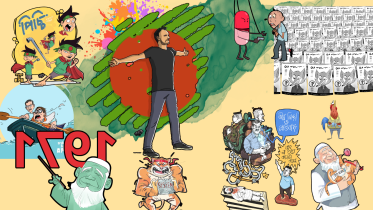


During the July Uprising, artists in the field of cartooning played a crucial role in unmasking the essence of authoritarianism. Amidst the oppressive governance, many of these artists were imprisoned under the contentious Digital Security Act. Despite the looming threats, they persisted in utilizing their artistic creations to shed light on corruption, absurdity, and injustice. Through their satirical illustrations, they wielded a potent tool that transcended fear and censorship, exposing truths that mere words often failed to convey.
Despite the momentum of the movement, the scope for political cartooning remains restricted, particularly during electoral periods. Presently, some cartoons tend to serve as instruments of endorsement for specific political factions rather than as critiques of the existing system. Against the backdrop of unfolding political theatrics, a prevailing query emerges: why is there a notable lack of interest among cartoonists in addressing election-related themes through their artwork?
In a quest for answers, insights were gleaned from four cartoonists to grasp their fervor for political cartoons and the factors that drive their unwavering dedication to this demanding domain, notwithstanding the uncertainties.
In numerous nations, political leaders articulate their views with calculated and diplomatic language, allowing cartoonists to derive satire from the underlying implications of these carefully crafted statements—deciphering concealed meanings and exposing inconsistencies through nuanced commentaries. Conversely, when leaders adopt a more forthright approach, the task becomes more straightforward and immediate. Yet, in Bangladesh, the creative space remains constricted. The confines of permissible expression, both in terms of content and style, continue to mold the tone and frequency of political satire.
Mehedi Haque, a Senior Cartoonist at The Daily New Age and Executive Editor of UNMAD, candidly discussed the current risks associated with his profession. His sentiments resonate with a broader reality: political cartooning in Bangladesh has transcended mere artistic expression to become an avenue for public accountability—a realm that demands fortitude, self-restraint, and a perpetual balancing act between freedom of expression and personal safety.
“My publication often receives legal notices or direct communications concerning my cartoons. However, these external pressures do not sway either my publication or myself. We stand by our convictions. The pressures come from various quarters. For instance, my friends and family constantly fear the potential perils arising from my profession, and paid commentators endeavor to tarnish my reputation on social media. Nevertheless, I seldom pay heed to such negativity,” Mehedi articulated.
For many cartoonists, the challenges extend beyond legal ramifications to encompass a broader milieu of societal pressure, surveillance, and public animosity.
Morshed Mishu, a Cartoonist and Assistant Editor at UNMAD, highlighted a distinct quandary—creative fatigue induced by the prevailing political landscape itself. “I struggled to recollect the last time I sketched a political cartoon. I believe it was following the assault on Nur. Since then, I have refrained from creating any cartoons related to the ongoing election. Their statements and actions already possess a caricature-like quality, leaving little room for me to artistically portray them. Political cartoons typically thrive on multiple layers—varied perspectives, subtle critiques—but in this context, everything is glaringly literal.”
Natasha Jahan, an artist at The Business Standard, expressed a sense of emotional exhaustion. “Frankly, I feel disheartened. I have undergone a personal transformation. The prevailing atmosphere is deeply disillusioning. Individuals whom I once held in high regard, whom I esteemed, have undergone a metamorphosis. Whom do I hold accountable now? Whom do I blame? I reckon it’s our own failing—we misplaced our trust. Nevertheless, I strive not to be entirely self-defeating. I persist, albeit gradually. However, the envisioned evolution of cartoons has not materialized. That conducive environment seems elusive.”
Zahidul Haque Apu, a Freelance Cartoonist and Senior Manager of Content at Hoichoi Bangladesh, highlighted another structural impediment. “Typically, I do not create political cartoons on a regular or professional basis. Perhaps some cartoonists have lost interest due to the lack of acknowledgment for their contributions. Artists, whether in the political sphere or otherwise, anticipate a degree of recognition, akin to musicians or writers. When this validation is absent, motivation wanes. Hence, the tepid involvement of political cartoonists in the electoral discourse, despite the presence of several talented individuals producing commendable work.”
Beyond motivation and acknowledgment, political cartoonists in Bangladesh continue to navigate a landscape fraught with risks—be it legal, social, or personal. Natasha Jahan highlighted how critiques often devolve into personal attacks.
Morshed Mishu elucidated on the pervasive labeling that follows political dissent.
Even indirect pressures can significantly influence artistic decisions.
Despite these constraints, each artist recounted instances where their creations bore a deeply personal imprint—moments when their illustrations encapsulated their sentiments and mirrored the political zeitgeist.
“There are numerous noteworthy creations, but given the context of election cartoons