
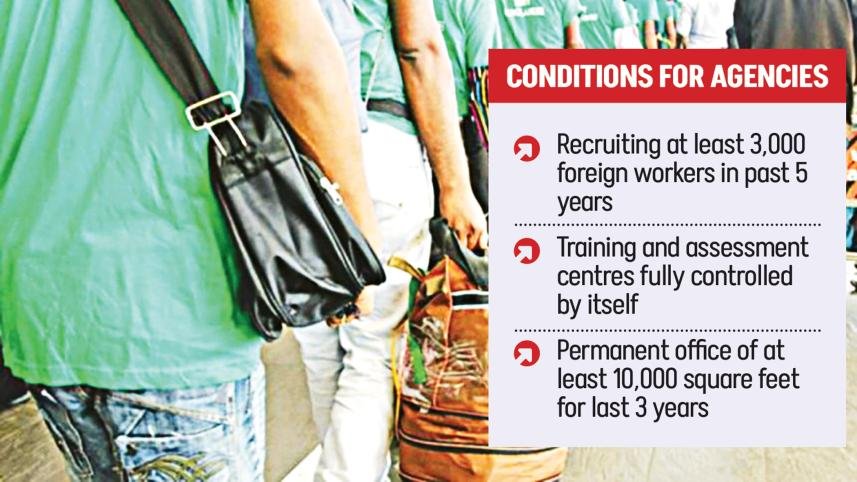


The modifications to the selection criteria for Bangladeshi recruiting agencies in Malaysia have sparked concerns among migration experts, industry insiders, and government officials. Out of the 10 conditions outlined by Malaysia for the upcoming labor intake, seven are deemed reasonable and achievable by many of the over 2,000 licensed agencies in Bangladesh. These conditions include holding a valid license for at least five years, having experience in sending workers to a minimum of three countries, possessing a certificate of good conduct, maintaining a clean record free of forced labor, trafficking, extortion, money laundering, or violations of labor laws, as well as providing written employer endorsements. However, the remaining three conditions have raised significant alarm.
The stipulation that agencies must have facilitated the recruitment of at least 3,000 workers in the past five years, establish and manage training and assessment centers independently, and maintain a permanent office spanning at least 10,000 square feet for three years are criteria that few agencies can meet. These requirements are not only impractical but also appear unnecessary. For instance, the mandatory training center provision is seen as redundant as Malaysia does not specify particular training requirements, as highlighted by a former joint secretary of the Bangladesh Association of International Recruiting Agencies (BAIRA). These conditions could potentially inflate recruitment costs, which have already surged to Tk 450,000-600,000 despite a government cap of Tk 79,000 before the market closure in 2024.
Similarly, the mandate for a large office space seems unjustified as it has not been proven to enhance recruitment quality or safeguard workers. The threshold of 3,000 recruited workers is unattainable for most local recruiters amidst challenges posed by the Russia-Ukraine conflict, global economic downturn, prevalent syndication in the Malaysian labor market, and the closure of labor avenues by key destination countries in recent times. Given these circumstances, the stringent conditions have instigated concerns of potential syndication, concentrating power in a few dominant recruiting agencies while limiting fair competition within the sector and jeopardizing worker protection.
Recalling the detrimental impacts of the syndicate eras from 2016-18 and 2022-24, where a handful of agencies, reportedly supported by influential figures in both nations, monopolized the market, escalated migration costs to unsustainable levels, and ultimately led to Malaysia suspending recruitment due to widespread labor exploitation, enforcing these new conditions would essentially replicate past issues, as expressed by a migration researcher. Initial requests by Malaysia for a list of compliant agencies by November 15 were later extended, with around 1,000 agencies having applied for selection and approximately 500 being shortlisted by the expatriates’ welfare ministry. Despite these developments, concerns regarding the new criteria persist.
It is imperative for the Malaysian government to reassess and restructure the selection process to ensure fairness without unnecessary complexities or susceptibility to syndication risks. Bangladesh, on its part, must diligently screen its recruiters, enforce cost limitations, and prioritize worker welfare in negotiations. Only through a transparent, competitive, and accountable recruitment framework can the exploitation that has plagued Bangladeshi workers in Malaysia and other markets be effectively prevented.