
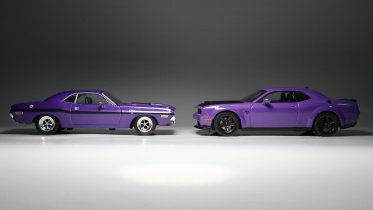


The newest addition to my collection is a striking pair of Mopar classics, featuring a 1970 Dodge Challenger R/T with a robust 7.2-liter V8 engine alongside its contemporary counterpart, the 2018 Challenger SRT Demon equipped with a potent 6.2-liter supercharged V8 powerplant. Interestingly, despite originating in Bangladesh, both models have traversed multiple international borders. The ’70 Challenger was sourced from DeAgostini/Altaya for the European market, while the Demon was imported from IXO America for the US market.
Since acquiring the 1970 Challenger in 2022, I had been on the lookout for its modern equivalent. Solido had released the 2018 Challenger in a similar deep purple hue, manufactured in Bangladesh at the Uttara EPZ in Nilphamari, making it even more appealing to me. The quest to complete this duo became a personal mission.
One challenge was the absence of local outlets for collectors in Bangladesh, as the factories only catered to exports. I had to rely on local Facebook groups that imported limited quantities for enthusiasts. Unfortunately, I missed the ordering window and was left empty-handed. However, further investigation revealed that IXO America had also launched a purple Challenger in 1/43 scale, also produced in Bangladesh.
A stroke of luck came through trade policies, as US tariffs on Chinese products forced IXO America to label its models as ‘Made in Bangladesh,’ benefiting from a lower tariff rate of 10%, now increased to 20%, compared to goods from China. This technicality served as my loophole, and with assistance from a contact overseas, I successfully brought together both generations of Challengers after a patient wait of over three years.
When placed side by side, the resemblance between the two is remarkable, showcasing similar bodylines, proportions, and stance. Despite being nearly fifty years apart, both exude the same raw and unfiltered energy that has defined the Challenger legacy. While the modern Demon has a smaller engine displacement, its supercharged V8 generates over 415 additional horsepower compared to the older 440 Six Pack engine, embodying the spirit of American muscle.
However, both models have minor imperfections. The 1970 Challenger lacks sharp detailing, with slightly flat headlights and a grille that is not perfectly aligned. On the other hand, the 2018 Demon captures aggression more effectively, but the wheels seem slightly off, likely due to the omission of replicating the track wheels’ design.
Overall, the Demon excels in accuracy and presence between the two. Despite their flaws, both models make captivating display pieces, and it is a source of pride to know they were crafted in Bangladesh.
The journey to unite these cars – matching in color, scale, and country of origin – was a test of patience that culminated in pure satisfaction. Now, the ultimate question remains: which one is deserving of the coveted garage queen title?