
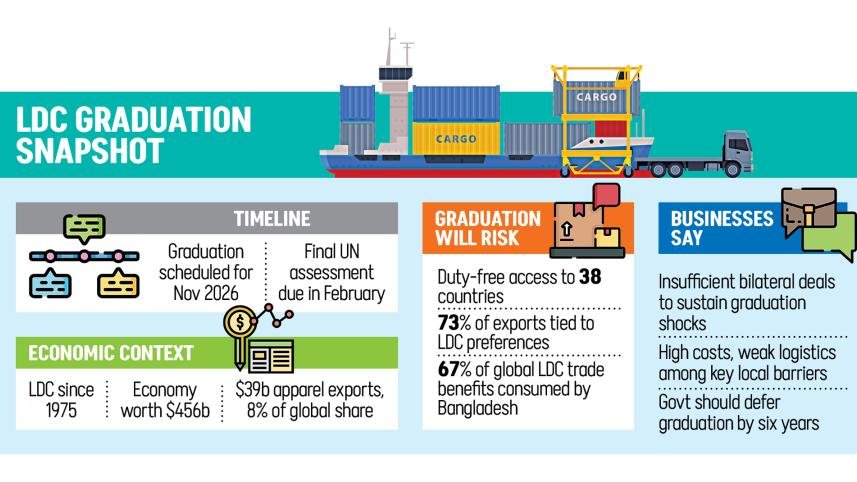


Less than a year remains before Bangladesh exits the category of least developed countries, but businesses express concerns about being unprepared for the challenges of transitioning to a developing nation. The absence of trade agreements that would secure preferential market access post-graduation is a major worry for exporters. Domestic weaknesses like limited product diversification, high production costs, and deficient infrastructure further hinder competitiveness against neighboring countries.
Manufacturers fear losing around $8 billion annually in overseas sales currently safeguarded by preferential treatment if the government proceeds with graduation without adequate readiness. Despite the interim government’s commitment to the November 2026 deadline for graduation, growing resistance prompted an assessment by the United Nations Committee for Development Policy (UNCDP).
Studies suggest that Bangladesh could face a significant loss of export earnings, approximately $8 billion, representing 14% of its annual export revenue, as preferential access diminishes upon graduation. Presently, exporters benefit from duty-free or preferential entry to 38 countries and various trade blocs, with 73% of national exports taking advantage of these perks.
The government’s Smooth Transition Strategy (STS) aims to mitigate the shock of graduation by securing trade agreements with major partners to maintain market access post-graduation. However, progress has been sluggish, with only one preferential trade agreement signed with Bhutan so far. Negotiations with Japan on an Economic Partnership Agreement are nearing completion, but talks with other key partners and blocs continue without clear timelines.
Businesses at home complain of worsening conditions, citing bureaucratic delays, policy uncertainties, and infrastructure bottlenecks that inflate costs and erode competitiveness. Industry leaders emphasize the need for a clear roadmap for the post-LDC period and urge the government to consider deferring graduation by at least six years to address various challenges.
Concerns about inadequate preparation and potential economic instability persist among economists, urging the government to focus on key priorities like reducing business costs, enhancing law and order, improving customs procedures, and securing GSP Plus status from the European Union post-graduation. While the option of deferment remains, the impending national election and political transition add complexity to decision-making processes.
Despite the challenges ahead, some view graduation as an opportunity to drive long-awaited reforms and improvements in the business environment. The government has identified 12 priority export sectors beyond garments and is actively working to enhance compliance and overall business conditions.