
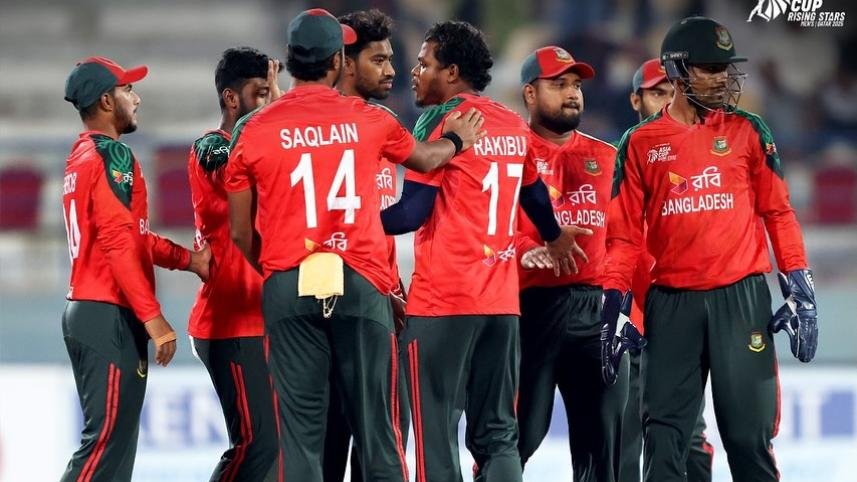


Focus on evaluating performances takes precedence over winning trophies in age-level or Emerging teams’ tournaments. Despite a heart-wrenching loss in the final, Bangladesh ‘A’ team’s participation in the Asia Cup Rising Stars in Doha, Qatar, can be deemed a success.
Leading the team, Akbar Ali’s squad faced a gripping defeat against Pakistan Shaheens in an intense Super Over showdown on Sunday. Notably, standout performances were delivered by key players like opener Habibur Rahman Sohan, who emerged as the third highest run-scorer and second highest in hitting sixes, and pace bowler Ripon Mondol, who excelled as the leading wicket-taker.
While the final outcome does not overshadow the overall positive assessment, it does raise concerns within the broader context.
Throughout the tournament, the ‘A’ team exhibited challenges in correctly analyzing pivotal match situations, a recurring theme evident not only in national teams but also across various levels in Bangladesh cricket.
The shortcomings evoked memories of past disappointments, such as the men’s national team’s failure to secure two runs off three balls against India in the 2016 ICC T20 World Cup and the recent defeat of the women’s senior team against Sri Lanka in the ICC Women’s ODI World Cup, falling short while requiring 12 runs off 12 balls.
In a close call during the semifinal against India, the ‘A’ team narrowly escaped defeat in the Super Over chasing a one-run target. Prior to that, a series of errors had led to the match proceeding to the tie-breaker phase.
In the final clash, Bangladesh ‘A’ bowlers effectively contained the Shaheens, limiting them to a modest total of 125.
Although Habibur provided a strong start to the chase, the team faced adversity after his departure at 26 runs off 17 balls, resulting in a slump from 36 for 2 to 53 for 7.
During this critical phase, the team’s strategy should have focused on neutralizing the threat posed by Sufiyan Muqeem, yet they lost three wickets carelessly to the left-arm leg-spinner.
Struggling to counter the googly deliveries, even seasoned player Yasir Ali, with prior Bangladesh experience, succumbed by offering a simple catch to extra cover.
Despite a valiant effort by the tailenders guiding the team to a Super Over, the opportunity for redemption was squandered as the batters failed to capitalize.
During the Super Over, after Pakistan’s Ahmed Daniyal bowled a wide resulting in five runs and an additional delivery, Bangladesh ‘A’ had a lead with four deliveries remaining and six runs already on the board, albeit having lost the wicket of Abdul Gaffar Saqlain.
Regrettably, instead of playing sensibly, Jishan Alam attempted an ambitious shot to a length delivery, losing his wicket and prematurely concluding the innings with three deliveries left, setting up a seven-run target that the Shaheens successfully chased down with two balls to spare.
Mohammad Ashraful, the Tigers’ batting coach during the recent Ireland series, emphasized in an interview with The Daily Star that Bangladesh’s longstanding issue lies more in the mental aspect rather than technical skills.
“This persistent problem dates back to my playing days. To cultivate a strong batting unit, players must exhibit independent thinking, craft individual game strategies, and comprehend match situations effectively,” he stated.
Jishan’s decision-making during the crucial moment epitomized this ongoing challenge of players struggling to align their choices with the match dynamics. Ultimately, the defeat in the final symbolized not just a setback but the ongoing struggle that continues to haunt Bangladesh cricket at all levels.