
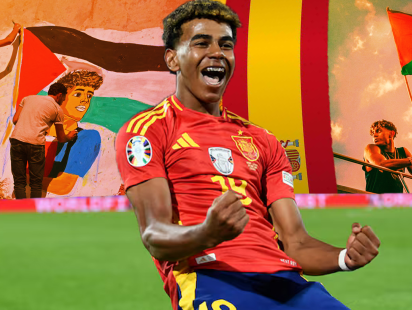


At a mere 18 years old, Lamine Yamal of Spain embodies the quintessential Gen Z aspiration. Recognized as a football prodigy set to dominate the sport for the next decade, his impact transcends the field. Beyond the chatter surrounding his lifestyle, social events, and dating speculations, Yamal consistently emphasizes his Muslim faith and cultural background.
The city of Barcelona erupted in jubilation on May 11th, celebrating their 29th La Liga triumph over rivals Real Madrid in El Clásico. Approximately 750,000 enthusiasts thronged the streets to witness the team’s customary open-top bus procession. Despite missing the game due to injury, Yamal captivated the audience. Amidst the cheers and pyrotechnics, the teenager proudly waved a Palestinian flag from the bus, distinct in a sea of blue and red emblems.
This scene, amidst a fervor of flags and supporters, transcended the realm of football, igniting discussions spanning politics and social media. The overwhelming acclaim he garnered signifies a shift in expectations, with fans no longer demanding complete silence from their idols.
Yamal shared images of the event on his Instagram, triggering instant and polarized reactions. The most profound response occurred offline. Just two days later, on May 13th, Palestinian artists immortalized the moment by painting a colossal mural of Yamal brandishing the flag on the remnants of a demolished structure in a Gaza refugee camp.
When questioned about the incident, his club’s manager, Hansi Flick, expressed discomfort, conceding his aversion to such gestures. Flick maintained that football’s purpose is entertainment, yet acknowledged Yamal’s autonomy in decision-making.
The episode soon garnered political attention, with the Israeli defense minister accusing Yamal of “inciting hatred” against the nation. Conversely, Spanish Prime Minister Pedro Sánchez came to his defense, asserting that displaying solidarity through a flag should not be construed as hateful. Sánchez contended that Yamal had simply articulated the sentiments of millions of Spaniards.
Barcelona has emerged as a prominent hub of pro-Palestinian activism in Spain since the Gaza conflict’s outbreak. In this context, Yamal’s gesture resonated with a broader public sentiment prevalent in certain segments of Spanish society.
This incident marks one of many instances where Yamal has vocalized his identity. Earlier this year, during Spain’s match against Egypt, anti-Muslim chants from a faction of spectators incited online backlash. Yamal subsequently addressed the issue on Instagram, asserting his pride in his Muslim heritage and condemning such behavior as disrespectful, ignorant, and racist.
In the contemporary era, athletes are evaluated not solely based on trophies and accolades but also on their conduct away from the field. For Yamal, this is just the beginning of a career that already seems disproportionately significant for his age. Amidst his social gatherings, fashion posts, and on-field exploits, the image of him waving the Palestinian flag now forms a part of his public persona.