
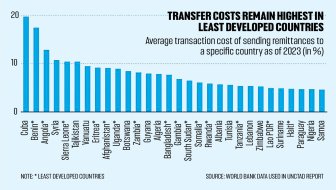


Bangladesh is among the least developed countries with one of the highest remittance transfer costs, averaging 7-8 percent. The United Nations Conference on Trade and Development (UNCTAD) highlighted Bangladesh in a recent global trade update in 2023 by the World Bank.
With millions of migrant workers, predominantly in the Middle East, sending money back home, Bangladesh ranks in the top 10 remittance-receiving countries globally, aiding in fulfilling a significant portion of its external payment requirements. The UNCTAD report noted that least developed countries (LDCs) account for half of the nations with the highest remittance costs worldwide, with Benin and Angola having the highest costs and Lao PDR and Haiti having the lowest among LDCs.
The UNCTAD report, released on September 4, mentioned significant advancements in Africa, indicating a rise in mobile money usage among adults in sub-Saharan Africa from approximately 27 percent in 2021 to about 40 percent in 2024. The Pan-African Payment and Settlement System (PAPSS) is also contributing to reducing cross-border transaction expenses and lessening reliance on offshore clearing.
While globally, digitally deliverable services trade is expanding rapidly, LDCs are not keeping up with this growth. The report highlighted that over the past decade, global services exports grew by approximately 6.7 percent annually, surpassing goods exports, with a notable 8.3 percent increase in 2025. Digitally deliverable services (DDS) trade grew faster than total services, representing 56 percent of global services exports, with LDCs benefitting significantly less from this growth.
Furthermore, the report emphasized the significance of “servicification,” which involves using services as inputs across various sectors, such as logistics, finance, and data management, driving economic diversification and global value chain participation. However, it pointed out the challenges faced by developing countries like Bangladesh, including poor connectivity, expensive cross-border payments, and skills gaps hindering their trade participation.