
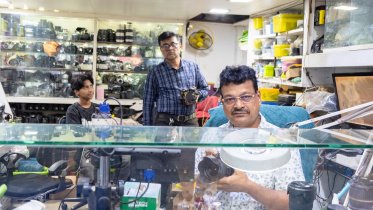


For many photographers in the bustling city of Dhaka, Anupom Singha Khokon serves as the go-to person when their cameras hit a snag, lenses get fungus, or old film bodies need revival. With over three decades of experience in camera repairs as the owner of Khokhon Camera Care in Dhaka’s New Market, Khokon’s affinity with cameras dates back to a time long before the digital era, mirrorless devices, or error prompts on screens.
“I have been immersed in the world of cameras for a considerable period,” he discloses. His journey with photography began in his childhood days. “I picked up photography skills when I was just in the 5th grade. We ran a studio business.”
During that era, photography was synonymous with film. Khokon’s early education in the field was not through formal schooling but through daily exposure to the family studio. Observing others at work, he grasped the art of capturing images and gradually mastered the entire process.
“In those days, photography revolved around film. You had to develop the film and then print the images using an enlarger machine,” he reminisces. Khokon actively participated in both processes. “I used to print photos and take pictures in the studio back then.”
Khokon’s entry into the profession was more practical than traditional. Following his SSC examinations, he delved deeper into photography, engaging in studio photography, outdoor shootings, and reportage.
“After my Matriculation exams, I fully immersed myself in the profession,” he states. This period coincided with a unique phase in the media industry. “Most news gatherers did not have the know-how to operate cameras. They collected the news, while we handled the photography.”
Subsequently, he pursued a diploma in photography at the Begart Institute of Photography, founded by Manzoor Alam Beg, and later apprenticed under the renowned photographer.
One key factor contributing to Khokon’s enduring relevance is his adaptability to every significant shift in camera technology. Starting with mechanical film cameras, he navigated through the integration of electronic systems into mechanical bodies, the era of DSLRs, and the current trend of mirrorless systems.
“Each innovation brought something novel,” he elucidates. “Initially, only mechanical cameras existed. Then came the incorporation of electronics into mechanical systems. Subsequently, we witnessed the advent of shutters and DSLRs.”
Upon the introduction of DSLR cameras, he realized the need for continuous learning. Looking ahead, he acknowledges the prevalence of mirrorless cameras and anticipates the potential integration of AI in the future. According to Khokon, embracing technological advancements is vital. “With a firm grasp of the basics, no challenge is insurmountable.”
Khokon highlights the misconception surrounding the role of a camera engineer in modern times. The profession has transcended mere mechanical repairs, with modern cameras communicating through digital error notifications that may not always be accurate.
“Nowadays, cameras themselves pinpoint issues through error messages appearing on the screen—Error 20, Error 30, Error 40. Deciphering these messages is crucial. However, their accuracy is not guaranteed every time,” he notes.
Repairing lenses poses an equally technical challenge. “In lenses, issues often manifest as communication breakdowns,” he explains. “The stabilizer might malfunction, or the autofocus motor could be faulty.” Khokon notes the evolution of lens mechanics, particularly the shift to newer magnetic motor systems replacing the conventional gear-driven mechanisms.
To Khokon, repair goes beyond replacing defective parts; it commences with a profound understanding of how a camera should function. Therefore, he emphasizes the indispensability of photography knowledge.
“Repairing cameras without a photography background is arduous,” he asserts. “A technician must grasp photography fundamentals first.” Understanding aperture, shutter speed, ISO, and output is paramount to effective camera repairs. “Mastery of photography is imperative for proficient camera maintenance.”
When queried about common mistakes made by camera users, Khokon’s response is straightforward: inadequate maintenance.
“Proper camera care is paramount,” he emphasizes. Bangladesh’s humid climate poses a significant threat to lenses, making them susceptible to fungus. “To prevent fungal growth on lenses, correct storage is essential. Utilize a dry cabinet or employ silica gel in an airtight container.”
He also cautions against dust and sand infiltration. “In locales like Cox’s Bazar, sand often infiltrates through lens crevices, causing jamming,” he explains. “The lens may produce a scratching sound due to sand particles, hindering smooth movement.” Khokon observes that many repair tasks could be preempted with improved handling and storage practices.
While digital cameras dominate the market, Khokon notes a resurgence of interest in film cameras.
“The demand for film cameras has surged significantly,” he reveals. Although film is now a pricey commodity, the appeal endures. “Occasionally, individuals bring their grand