
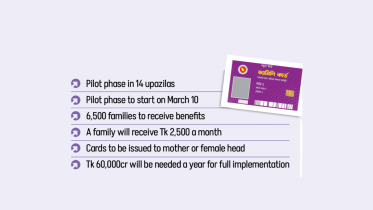


The government is preparing to roll out the initial phase of its family card initiative on March 10, aiming to gradually include two million families in a monthly cash support program. Prime Minister Tarique Rahman will officially kick off the four-month trial in 14 upazilas, where eligible families with a minimum of five members will receive Tk 2,500 monthly via direct transfers to their mobile wallets or bank accounts.
The pilot phase will cover 6,500 families initially, with plans to expand the scheme nationwide in stages, as outlined in the Family Card Piloting Implementation Guidelines 2026 and the Family Card Policy Paper. The decision was made during a cabinet committee meeting chaired by Tarique recently.
If fully executed, the program, a significant electoral promise of the BNP, is estimated to cost around Tk 5,000 crore monthly, totaling approximately Tk 60,000 crore annually, potentially becoming the largest social spending commitment in the country’s history. The anticipated yearly budget would represent nearly 12 percent of this fiscal year’s revenue target.
The draft proposal, crafted by the social welfare ministry, envisions evolving the family card into a “Universal Social ID Card” for every citizen by 2030, while boosting the social security budget to 3 percent of GDP by 2028. Currently, the government runs 95 social safety net programs across 23 ministries, with an allocation of Tk 1.26 lakh crore in the current fiscal year, equivalent to 1.87 percent of GDP.
Under the new initiative, cards will be issued in the name of the mother or female head of the household. Beneficiaries will be chosen using Proxy Means Test (PMT) scoring, a methodical poverty assessment technique. Rural families owning 0.50 acres or less of homestead and cultivable land will be eligible, with income and assets evaluated to identify poor and ultra-poor households.
Families will be disqualified if any member is a regular government employee, pensioner, holds a commercial license, large business ownership, or possesses a car or air conditioner. Priority will be given to the landless, homeless, individuals with disabilities, and marginalized communities like hijra, Bede, and small ethnic groups.
Selection processes will be conducted by committees established at various administrative levels. The program will be monitored by government officials under a two-tier verification system to minimize errors.
The draft plan specifies that existing TCB cards will be merged into the family card’s Dynamic Social Registry. Using the same smart card with OTP verification, beneficiaries can purchase essential food items at subsidized rates and potentially access services such as education stipends and agricultural subsidies in the future.
The core principle of the program emphasizes that the family, not the individual, is the fundamental unit of development, aiming to eliminate duplication and enhance coordination among existing programs to ensure inclusion of the actual poor population.
In the pilot phase, one ward in each upazila will be targeted initially, with plans to expand gradually to encompass entire upazilas for universal coverage. The selected 14 upazilas for the pilot program include various areas in Dhaka, Rajbari, Chattogram, Brahmanbaria, Bandarban, Khulna, Bhola, Sunamganj, Kishoreganj, Bogura, Natore, Thakurgaon, and Dinajpur.
Over Tk 2.10 crore has been designated for the pilot phase, with cash transfers directly to beneficiaries’ mobile wallets or bank accounts through the government-to-person (G2P) system. The first month’s assistance will be disbursed immediately after the launch.
Ward-level committees will conduct door-to-door data collection, surveying at least 1,000 families in each selected ward from February 26 to March 2 for beneficiary selection. Following online data entry and PMT scoring, Department of Social Services personnel will verify the information on-site. Final approval is scheduled for March 8 and 9, after which QR-coded digital smart family cards will be issued.
Minister Zahid emphasized that beneficiary selection will solely rely on field-level data collection, ensuring inclusivity without involvement of intelligence agencies or political elements. The program targets the ultra-poor, poor, and lower-income families, with benefits channeled to the mother as the household head to promote self-reliance and future generational benefits.
Initial funding for the ongoing fiscal year will be sourced from block allocations by the finance ministry, with plans to integrate the program into the regular national budget from the upcoming fiscal year.