
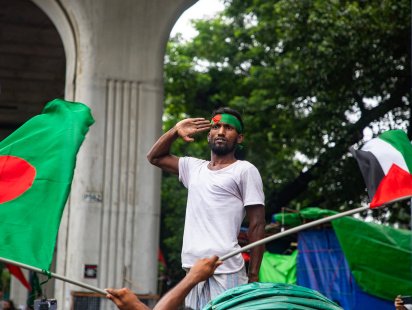


In the aftermath of the July Uprising two years ago, ongoing public discussions persist regarding constitutional reforms, transitional justice, institutional restructuring, and other related matters. While these issues are crucial for the country’s democratic progression, the prevalent focus on changes in authority and power dynamics overlooks a significant aspect of the uprising – its impact on reshaping public credibility.
The past two years have seen a shift in the nature of disagreements, extending beyond political reforms and elections to encompass disputes over whose version of events holds credibility. Various entities such as student leaders, political parties, journalists, civil society groups, victims’ families, and government officials present conflicting interpretations of the uprising’s objectives, the current state of the nation, and its future direction. This divergence now revolves around determining whose narrative garners trust, highlighting a fundamental change in how public credibility is perceived post-July.
During the 2024 uprising, official narratives clashed with smartphone footage, eyewitness accounts, independent reporting, and information disseminated through informal channels. This shift has elevated the value of personal observations and evidence shared by ordinary citizens, challenging the traditional sources of credibility like government bodies, newspapers, and universities. The uprising underscored a distinction between political authority and public credibility, emphasizing the importance of trustworthiness beyond formal institutions.
The evolution of public credibility post-July signifies a deeper democratic accountability, empowering citizens to question authority, demand transparency, and hold power accountable. However, this progress presents a new challenge – the need to establish trustworthy public institutions in an environment where credibility itself is contested.
Debates surrounding constitutional reforms, justice mechanisms, election timelines, and the narrative ownership of the uprising have increasingly become battles over credibility. While social media has enhanced democratic engagement, it has also accelerated the spread of misinformation and biased narratives. The key challenge now is not merely equitable power distribution but fostering institutions that can earn and maintain public trust in this evolving democratic landscape.
In the wake of skepticism toward established authorities, there is a growing need to restore confidence in institutions like the judiciary, media, universities, and public bodies. Their legitimacy should be based on integrity, independence, competence, transparency, and commitment to truth, rather than political affiliations. Citizens play a vital role in this process by examining all claims critically, regardless of their political preferences, to uphold democratic values and public reasoning.
Ultimately, the enduring impact of the July Uprising lies in not just changing the governance structure but also in redefining the criteria for evaluating authority. The success of democracy in Bangladesh hinges on fostering a culture where credibility is earned through evidence, integrity, and accountability, rather than assumed based on status or ideology.