


Former finance adviser Salehuddin Ahmed revealed that around 60 percent of individuals who submitted e-returns did not report any taxable income during his time in the interim government. Ahmed expressed astonishment at the statistic, highlighting that the tax-free threshold was Tk 3,50,000 and even rickshaw pullers often surpass this income level. He attributed the poor tax collection by the National Board of Revenue (NBR) to people’s reluctance to file taxes.
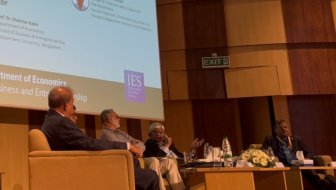
Speaking at a seminar on the proposed budget for fiscal year 2026-27 at Independent University, Bangladesh (IUB), Ahmed emphasized the resistance within the NBR towards automation and digitization, which hampers tax collection efforts. He suggested that the inclination for taxpayers to visit NBR offices could be due to the potential for officials to solicit bribes, a scenario less likely under digital systems.
During his tenure, Ahmed identified 11 sensitive cases of money laundering abroad, with successful recovery projected within three to four years. He recounted an incident where Indian conglomerate Adani threatened to disrupt electricity supply to Bangladesh but resumed service after a payment of Tk 100 crore facilitated by the finance ministry through the energy ministry.
Ahmed criticized the contractual terms of agreements involving Adani and the Rampal power plant. Regarding the fiscal year 2027 budget, he supported an expansionary approach with a 3.6 percent GDP deficit, aligning with the government’s objectives. However, he cautioned that the NBR’s revenue target of Tk 700,000 crore was overly ambitious given current limitations in capacity and tax structures.
While acknowledging the government’s focus on sectors like education, health, and social security, Ahmed stressed the importance of ensuring effective allocation and monitoring of resources. Panellist Shamsuddin Ahmad, a former World Bank financial sector specialist, recommended recruiting more energy auditors to enhance transparency and reduce energy costs, emphasizing the connection between efficient energy use, pricing, and national development.
Additional speakers at the seminar included energy and sustainable development expert Ijaz Hossain, former Buet professor Md Fardous Alom, and joint secretary of the Ministry of Finance, Shahriar Kabir, who moderated the event.