
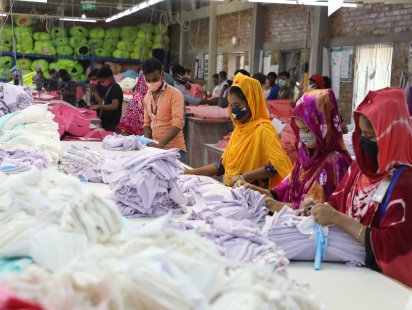


Bangladesh’s engagement in global value chains is primarily limited to lower-value segments, particularly in the garment industry. While the country’s garment-oriented model has brought about employment opportunities, exports, and confidence, there are concerns about its sustainability in terms of productivity growth, job quality, technological advancement, and export resilience. Bangladesh’s export landscape is heavily reliant on garment production, mostly carried out by millions of female workers for global markets. However, the country’s participation is mainly concentrated in lower-value stages such as cutting, making, trimming, and shipping. The majority of the value-added activities like fiber development, design, branding, logistics, and retail expertise are conducted elsewhere, leaving Bangladesh with limited influence over the chain’s organization.
The traditional strengths that bolstered Bangladesh’s competitiveness, such as low labor costs, scale, and preferential market access, are diminishing. Factors like rising wages, potential reductions in preference margins post Least Developed Country (LDC) graduation, and the rapid progress of competitor countries like Vietnam, India, Cambodia, and Indonesia pose challenges. Buyers now demand quicker turnaround times, product traceability, environmental compliance, smaller production batches, and enhanced flexibility. The conventional strategy of focusing on low-cost, high-volume production may not suffice for the next phase of development.
To progress, Bangladesh must upgrade its garment industry starting from textiles and inputs. The country heavily relies on imported woven fabrics, synthetic fibers, chemicals, dyes, and machinery. Enhancing capabilities in fabric development, synthetic fibers, technical textiles, design services, modern dyeing and finishing, and environmental management are crucial for competing in higher-value apparel segments. Additionally, diversifying product offerings to cater to evolving global demands like sportswear, outerwear, medical textiles, and sustainable fashion requires investing in skilled personnel, digital production planning, design capacity, and quality assurance.
Institutional constraints also hinder Bangladesh’s industrial advancement, characterized by a lack of a robust ecosystem connecting various industry stakeholders and inadequate support infrastructure. Moreover, the policy environment has favored the garment sector over other industries, resulting in an uneven playing field. To address these challenges, Bangladesh needs a comprehensive industrial policy that nurtures capabilities across sectors, promotes tariff rationalization, enhances access to inputs at global prices, facilitates technology upgrades, and supports SMEs. Developing a diverse industrial base, fostering regional production networks, and upskilling the labor force are key strategies for Bangladesh to transition from a garment-reliant economy to a more competitive and diversified industrial landscape.
Sustainability concerns, evolving market dynamics, and changing trade regulations further emphasize the need for Bangladesh to adapt and innovate. By focusing on productivity enhancement, quality improvement, and institutional strengthening, Bangladesh can elevate its industrial competitiveness and secure its position in the global value chains of the future.