
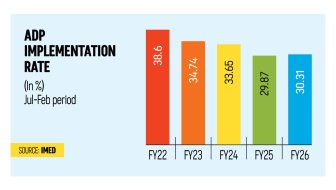


Government agencies have utilized only about a third of the yearly development budget in the initial eight months of the ongoing fiscal year due to administrative inactivity during the transition between interim and new administrations. Implementation Monitoring and Evaluation Division (IMED) reported that ministries and divisions spent 30.31 percent of their total allocation from July to February of FY2025-26, a slight increase from the previous year’s 29.87 percent. Despite the rise in implementation rate compared to the previous year, actual spending decreased.
Expenditure in the Annual Development Program (ADP) for the first eight months of FY26 was Tk 63,327 crore, lower than the Tk 67,553 crore spent in the same period of FY25. The development expenditure hit a historic low in FY25, with only 68 percent of the revised ADP implemented, marking the weakest performance since FY1976-77. The disruption last year was attributed to the political changes following the fall of the previous government, leading to project directors abandoning their roles.
The revised ADP for the current fiscal year amounts to Tk 208,935 crore. In terms of foreign loans, government agencies spent Tk 24,915 crore, which is 34.6 percent of the total allocation, a slight increase from the previous year’s 33.92 percent. However, the absolute spending decreased from Tk 27,471 crore in the corresponding period last year.
Economists attribute the slow implementation to administrative inertia and political uncertainty prevailing throughout the fiscal year. Prof. Lutfor Rahman from Jahangirnagar University mentioned that the period under the interim government saw low public engagement, resulting in less inclination to invest in development projects. He emphasized that the sluggish implementation has broader economic and social impacts, especially on employment linked to ADP spending.
Rahman expressed skepticism about a significant recovery in the remaining four months of the fiscal year, citing limited scope for improvement amidst approaching challenges like the monsoon season. He highlighted the visible deterioration of rural infrastructure due to delays in project execution. Rahman anticipated a slight enhancement in overall implementation by the fiscal year’s end but cast doubt on achieving full ADP execution.
Monzur Hossain from the General Economics Division (GED) of the Planning Commission noted the direct correlation between foreign loan disbursement and project progress, emphasizing that delays in implementation lead to decreased disbursement. He identified structural bottlenecks, particularly in investment projects, such as complex conditions and challenges in land acquisition. Hossain mentioned that with the new political government in place, project monitoring has intensified, priorities have been set, and delays are under closer scrutiny.