
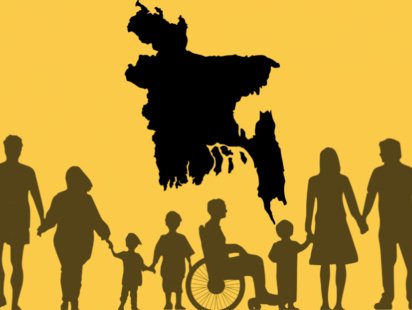


A recent report by the World Health Organization (WHO) reveals that 16% of the global population lives with a disability. In Bangladesh, this percentage translates to approximately 2.7 crore individuals, accounting for 15% of the total population, a figure comparable to the total population of Australia.
Amidst Bangladesh’s current political transition, there is a crucial opportunity to prioritize the rights, inclusion, and dignity of this significant segment of the population in the country’s reform and development agenda. The election manifesto of the Bangladesh Nationalist Party (BNP), with its commitment to advancing disability rights and supporting existing disability legislation, offers a hopeful prospect.
Bangladesh ratified the UN Convention on the Rights of Persons with Disabilities (CRPD) in 2007, becoming one of the pioneering nations globally, and enacted the Rights and Protection of Persons with Disabilities (RPPD) Act in 2013. Despite the introduction of implementation mechanisms such as a National Action Plan in 2018, the effectiveness of the country’s disability-inclusive initiatives remains constrained by a lack of robust implementation strategies, often confined to charity models.
The BNP manifesto outlines plans to update the current disability laws and the National Policy on Disability (1995) to ensure the effective implementation of rights-related laws. While this initiative signifies progress, it is pertinent to note that Bangladesh already established a comprehensive RPPD Act in 2013 and ratified the UN CRPD, both emphasizing the rights of individuals with disabilities. Hence, the focus should be on prioritizing the effective implementation of the National Action Plan 2018 under the RPPD Act by activating central and local disability committees and fostering inter-ministerial coordination.
Additionally, the BNP manifesto pledges to provide disability-friendly citizen services, including accessible travel infrastructure. However, transforming existing infrastructure to meet global accessibility standards poses a significant challenge, given that most current infrastructure was not designed with inclusivity in mind. Notably, the metro rail stands as the sole disability-accommodating mode of public transport, emphasizing the need for comprehensive infrastructure upgrades to ensure universal accessibility standards are met.
Rather than revising the national policy, BNP should concentrate on strengthening the Jatiyo Protibondhi Unnayan Foundation (JPUF), a specialized agency under the Ministry of Social Welfare dedicated to persons with disabilities. Enhancing the participation of individuals with disabilities in decision-making processes through increased recruitment within JPUF will be pivotal for driving positive changes.
As the renowned disability rights activist James Charlton highlighted, meaningful inclusion and empowerment of individuals with disabilities require leveraging their lived experiences and ensuring their active involvement in decision-making processes. Prioritizing persons with disabilities as beneficiaries of proposed family cards can help address their heightened economic vulnerabilities compared to other marginalized groups.
Furthermore, it is essential for BNP to address representational factors in its manifesto, particularly the usage of the term “people with special needs,” which contradicts the UN’s CRPD and Bangladesh’s RPPD Act 2013. This terminology implies a misconception that only individuals with disabilities require unique support, whereas, in reality, their fundamental needs align with those of everyone else, encompassing basic essentials for dignified living.
Disability is not solely an individual attribute but emerges from interactions with societal barriers. Structural obstacles, rather than individual impairments, often hinder inclusion. By shifting focus towards transforming institutions, environments, and attitudes to ensure equal participation, we can dismantle the barriers that impede the full inclusion of individuals with disabilities in society.
In conclusion, by translating the commitments outlined in the BNP manifesto into effective policies and practices, there is a potential to break the cycle of treating individuals with disabilities as part of the “surplus population.” Empowering individuals with disabilities to contribute equally to economic and social spheres can pave the way for a more inclusive and equitable society.