
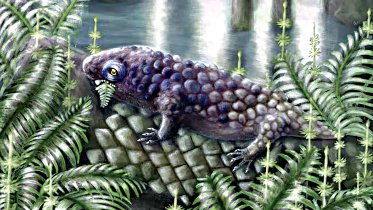


In Nova Scotia, Canada, scientists have uncovered the skull of an ancient creature that lived approximately 307 million years ago, making it one of the oldest herbivorous land vertebrates known to date. This discovery marks a significant milestone in the evolution of animals.
Known as Tyrannoroter heberti, this creature had a triangular-shaped skull that allowed for the development of robust cheek muscles to consume tough plant matter. Its mouth was equipped with specialized teeth designed to crush, shred, and grind vegetation.
Although resembling a reptile, Tyrannoroter is not classified within that group of animals but is instead considered part of a category known as microsaurs. While only the skull has been found by researchers, they estimate that Tyrannoroter measured around 12 inches (30.5 cm) in length and had a sturdy build similar to the modern blue-tongued skink, based on the anatomy of related species.