
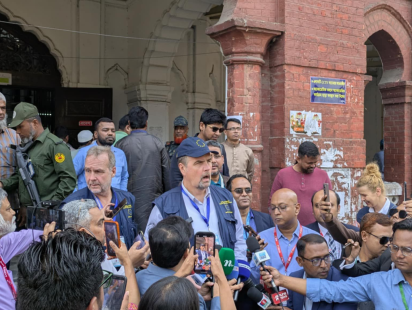


The Head of the European Union Election Observation Mission (EU EOM), Ivars Ijabs, hailed today as a significant milestone for democracy in Bangladesh. Speaking to the press at Siddheswari Girls’ College on New Bailey Road, Ijabs emphasized the importance of the day for the country’s democratic process.
Expressing confidence in a participatory, credible, and trusted election, the EU mission underlined its commitment to closely monitoring all aspects of the electoral process, including the vote tabulation, nationwide.
Ijabs further visited the polling center at Dhaka University’s Curzon Hall around 11:50 am. Following the visit, he announced plans to issue a preliminary report on the national election by Saturday.
The EU has deployed a total of 200 observers, with 90 serving as short-term monitors. This marks the first comprehensive EU observation mission in Bangladesh since 2008, with observers from Norway, Switzerland, and Canada also playing pivotal roles.
As reported by the Chief Adviser’s Office, there are 394 international observers overseeing the 13th general election and a national referendum, alongside 197 foreign journalists reporting on the electoral proceedings.
In contrast to previous elections, the current number of observers has significantly increased, with 80 representing organizations, 240 coming from bilateral countries, and 51 being affiliated with global institutions, more than double the figure recorded during the contentious January 2024 election.
Historically, there were substantially fewer monitors in past elections, with 158 in 2018, 125 in 2014, and merely four in 2008.
Key observer missions include the Asian Network for Free Elections (ANFREL) with 28 observers, the Commonwealth Secretariat with 27, the US-based International Republican Institute (IRI) with 19, and the National Democratic Institute (NDI) with one representative.
Additionally, other organizations such as the Organization of Islamic Cooperation (OIC) with two observers, the International Conference of Asian Political Parties (ICAPP) with two, and the European External Action Service with one observer are actively engaged in monitoring the election process.
Observers from 21 countries, including Pakistan, Bhutan, Sri Lanka, Nepal, Indonesia, the Philippines, Malaysia, Jordan, Turkey, Iran, Georgia, Russia, China, Japan, South Korea, Kyrgyzstan, Uzbekistan, South Africa, and Nigeria, have arrived to oversee the electoral proceedings.
Moreover, 51 individuals representing groups like Voice for Justice, Democracy International, SNAS Africa, the SAARC Human Rights Foundation, and the Polish Institute of International Affairs are independently monitoring the election for transparency and accountability.