


With Ramadan set to begin in slightly over a week, households are under increasing pressure due to escalating prices for essential items, a common occurrence during this period.
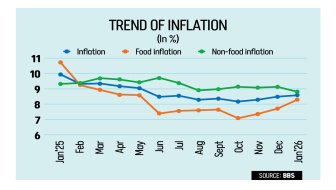
In January, food inflation, a key concern for the average citizen in Bangladesh, rose to 8.29 percent, marking an increase of almost 0.6 percentage points from December, as reported by the Bangladesh Bureau of Statistics (BBS).
The prices of fundamental food products have been steadily climbing in recent months, becoming the primary driver of overall inflation. Following a dip to 7.08 percent in October from 7.64 percent in September, food inflation surged in each of the subsequent three months.
Similarly, overall inflation displayed a comparable pattern. Despite a slight decrease of 0.19 percentage points in October, headline inflation resumed its upward trajectory, hitting 8.58 percent in January, according to BBS data.
In contrast, non-food inflation decreased by 0.32 percentage points in January to 8.81 percent, indicating reduced price pressures in sectors such as clothing, transportation, housing, and other services.
However, the relief provided by this decline in non-food inflation offers little solace to lower and middle-income groups, especially when the cost of food essentials continues to rise amid stagnant incomes. BBS data reveals that wage growth saw a marginal increase of only 0.1 percentage points, reaching 8.08 percent in January, trailing behind inflation rates consistently for almost four years.
Economists and policy experts attribute the recent spike in food prices to a mix of election-related expenditure and the seasonal demand surge before Ramadan. Zahid Hussain, a former lead economist for the World Bank in Dhaka, highlighted significant demand- and supply-side pressures in January, driven by private spending linked to the elections and a crisis in liquefied petroleum gas (LPG) supply.
The recent inflationary trend has been primarily fuelled by food prices, with non-food inflation demonstrating an overall decline, a trend observed in both rural and urban regions. However, the persistent high inflation rate remains a concern, standing at 8.66 percent on a 12-month average basis, well above the central bank’s target.
The inflation data indicates a challenging scenario for the central bank, leaving limited scope for monetary policy adjustments. The latest figures suggest that maintaining the current policy rate and stable exchange rates are the preferred actions for the Bangladesh Bank. Fahmida Khatun, executive director of the Centre for Policy Dialogue, echoed this sentiment, emphasizing the impact of electoral and Ramadan spending on food inflation and the overall inflation rate, necessitating a cautious approach in monetary policies.
While tightening monetary conditions can provide temporary relief, addressing supply-side issues is crucial for long-term inflation control. Hussain emphasized the need for a comprehensive approach to tackle the root causes of inflation, highlighting that temporary measures alone may not suffice to resolve the underlying problems.