
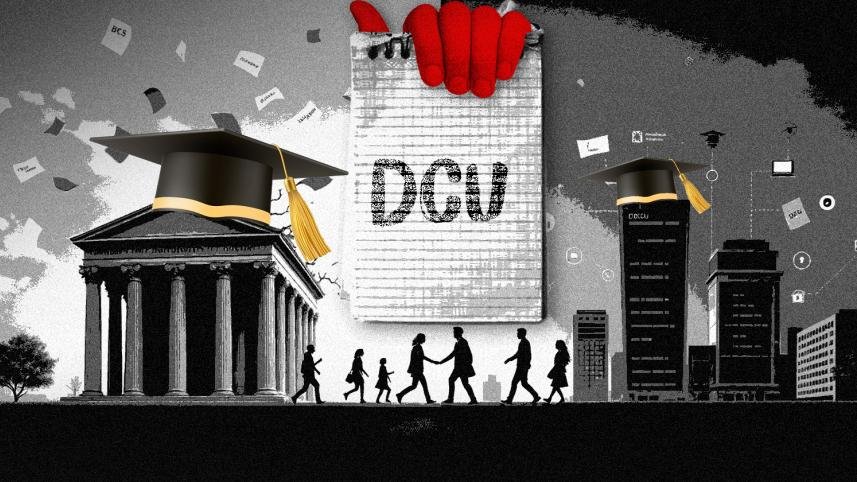


In the context of crisis, the Chinese term “wei ji” (danger and opportunity) reminds us that challenges can serve as moments for reinvention rather than solely as disasters. The recent standoff involving the seven government colleges previously under Dhaka University’s affiliation exemplifies such a transitional phase. Originally stemming from protests against DU’s administration, the issue has transformed into a separation process aimed at establishing a new university.
The expedited creation of Dhaka Central University (DCU) under pressure has led to current struggles in commencing classes post-admissions, formalizing regulations, and determining the faculty’s composition. These challenges have highlighted the limitations of the conventional university model, calling for the exploration of alternative approaches. The seven colleges—Dhaka College, Eden Mohila College, Begum Badrunnesa Government College, Government Bangla College, Kabi Nazrul Government College, Government Titumir College, and Government Shaheed Suhrawardy College—have navigated changing jurisdictions over time. Initially under DU’s governance, then the National University, and back to DU in 2017, this shifting landscape aimed to address governance, examination, and staffing issues. However, the swift decision-making process points to fundamental flaws within the current structure. The uncertainties surrounding the fate of students, faculty, and staff may necessitate temporary measures by the interim government. Nevertheless, this crisis presents an opportunity to address the deeper systemic issues prevalent in our educational institutions. It is imperative for the new university to break free from colonial legacies and align with our contemporary demographic, social, epistemic, and economic realities.
In his book “Dark Academia: How Universities Die,” Peter Fleming critiques late capitalism for contributing to the demise of universities. Fleming argues that the education system’s focus on audits, performance metrics, rankings, and competitiveness caters more to corporate interests than academic freedom. This approach drains the vitality from universities, rendering them stagnant and unresponsive. The central question revolves around whether the new university will perpetuate the colonial mindset that the seven colleges seek to escape.
Historically, Dhaka University and its counterparts—Calcutta, Bombay, and Madras University—were primarily established to train clerks for the British Empire’s administrative apparatus rather than foster intellectual growth. The remnants of this colonial legacy are evident in DU’s emphasis on the BCS exams and its role in producing a significant portion of the country’s civil servants. The existing hierarchical administrative structure and discipline-specific departments of public universities worldwide raise concerns about their adaptability to modern demands.
The University Grants Commission (UGC), responsible for overseeing all universities, is entwined with this colonial framework and has accepted its inherent contradictions. The challenges faced during the crisis involving the seven colleges underscore the inadequacy of an outdated administrative system to manage the examination processes for a large student population. While Bangladesh has expanded access to higher education, there is a lack of clarity regarding the purpose of public universities—whether they are elite research institutions, facilitators of mass education, credentialing hubs, or engines of social mobility. Both DU and DCU must grapple with this fundamental question.
As efforts are made to address ongoing issues, such as disputes over BCS General Education Cadre positions, concerns about degree recognition, and rapid infrastructure development, it is crucial to view this crisis as an opportunity for philosophical realignment. The perceived marginalization of students from the seven colleges reflects a reality where DU lacked the administrative capacity to oversee multiple dispersed institutions with large student bodies. The challenge lies in scalability rather than quality. To ensure DCU’s success, it must avoid replicating DU’s rigid structures under a new guise. The envisioned flexibility, interdisciplinary nature, and social engagement of the new university suggest a departure from traditional norms.
UGC’s proposal for a federated, multi-campus, school-based university utilizing the existing seven colleges aims to maintain accessibility, reduce immediate infrastructure burdens, and foster excellence through specialized schools or clusters. However, the primary concern revolves around the human element, particularly the fair transition of BCS teachers as integral components of the system. Transparent criteria for absorption, guided by best practices, can mitigate tensions and ensure a smooth transition process. Emphasizing discipline-specific, merit-based recruitment for university faculty positions is essential to avoid perpetuating outdated practices. Those not absorbed into university roles should be redeployed within the government college system or the higher-secondary streams of the seven institutions.
To prevent stagnation and foster innovation, DCU must transcend traditional departmental structures and prioritize interdisciplinary clusters relevant to the contemporary world. Addressing urban issues, environmental concerns, linguistic diversity, community health, and informal economies can enhance the university’s impact on Dhaka’s communities. The adoption of a hybrid learning framework, incentivizing stakeholders, and promoting intellectual openness and social accountability are essential for fostering a dynamic educational environment.
In conclusion, the crisis surrounding the seven colleges should be viewed as an opportunity for transformative growth rather than a setback. By embracing change, prioritizing inclusivity, and