
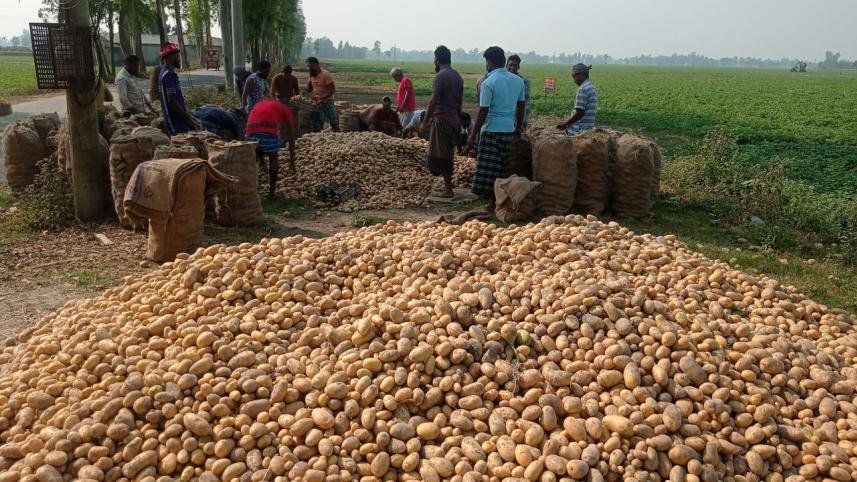


Bangladesh has witnessed an unprecedented surge in potato production this year, setting new records. Data from the Bangladesh Bureau of Statistics (BBS) reveals that potato production reached around one crore tonnes in the fiscal year 2023-24, escalating to approximately 1.15 crore tonnes in FY2024-25, marking a remarkable 9.17 percent increase from the previous year.
The significant expansion of potato cultivation this year can be attributed to marginal farmers’ strategic decision-making. Marginal farmers typically opt to grow crops that commanded higher prices in the previous year in pursuit of increased profitability. In 2024, the market price of potatoes soared, averaging Tk 50-60 per kilogram, incentivizing farmers to expand their cultivation efforts. Consequently, Bangladesh achieved its highest-ever potato yield in FY2024-25.
However, this bumper harvest has raised concerns as the record-breaking production far exceeded the annual domestic demand of approximately 90 lakh tonnes, resulting in a substantial surplus that drove potato prices down. Consequently, marginal farmers faced significant financial losses. Field production costs are estimated at around Tk 16/kg, with additional cold storage expenses of Tk 6-7/kg. Despite this, potatoes are being sold in local markets for a mere Tk 8.5-9.5/kg, leading to considerable losses for farmers. Wholesale prices, as reported by the Trading Corporation of Bangladesh (TCB), currently range from Tk 9-12/kg, while retail prices stand between Tk 15-20/kg. The drastic decline in potato prices by 61-63 percent over the past year has left farmers grappling with challenges, while the government struggles to manage the market surplus.
Numerous farmers and agricultural stakeholders have criticized the government for its failure to implement previously announced measures, such as establishing a minimum cold storage gate price of Tk 22/kg and procuring 50,000 tonnes of potatoes to stabilize the market. For instance, Akhtar Mia, a potato farmer from Rangpur who cultivated potatoes on 25 acres of land this year, reported an estimated loss of around Tk 30 lakh. He highlighted the discontinuation of loans provided by cold storage owners against stored potatoes, leading to further financial strain on farmers. Additionally, government assistance often fails to reach marginal farmers, as middlemen tend to reap most of the benefits.
The challenges faced by potato farmers this year may prompt many to reduce potato cultivation next year, potentially leading to reduced supply and higher prices in the market. This fluctuating pattern of welfare losses for farmers and consumers has been recurrent in Bangladesh’s potato market in recent times, underscoring the need for effective government intervention.
To address these issues and safeguard both farmers’ and consumers’ welfare, the Department of Agricultural Extension (DAE) could utilize data on crop allocation in each upazila to regulate potato cultivation. By assessing domestic demand and export volumes, the DAE could introduce cultivation limits to prevent excessive allocation of land to potatoes, encouraging diversification into other crops. This strategy not only promotes crop diversification but also enhances soil fertility and food security. Shifting towards a balanced mix of crops suited to local soil fertility could reduce import expenditures on food grains and steer Bangladesh towards self-sufficiency in food production.
If Bangladesh consistently surpasses domestic demand for potatoes, exploring and developing new export markets becomes essential. Despite being the seventh-largest potato producer globally, Bangladesh does not rank among the top 20 exporters. Expanding exports to new markets, particularly in the Middle East, could be facilitated through Free Trade Agreements (FTAs), enabling duty-free exports and boosting export volumes. Improving transportation infrastructure, such as establishing a direct railway route from North Bengal to Chattogram, could enhance export competitiveness and reduce costs significantly.
The Rangpur division, known for its abundant potato production and low-cost labor, presents an opportunity for developing agro-processing industries, particularly in potato-based products like chips and French fries. Investing in international-standard processing facilities in Rangpur could not only drive exports but also generate employment for vulnerable communities, contributing substantially to Bangladesh’s GDP. Moreover, importing high-dry-matter potato seeds suitable for chip and French fry production could enhance competitiveness in the processed potato industry, fostering a sustainable export market.
In conclusion, addressing the challenges in Bangladesh’s potato market requires a balanced approach that safeguards the interests of both farmers and consumers. Effective government intervention, coupled with strategic planning and investments in infrastructure and technology, is crucial to ensure the sustainable growth of the potato industry and enhance the overall agricultural sector in the country.