
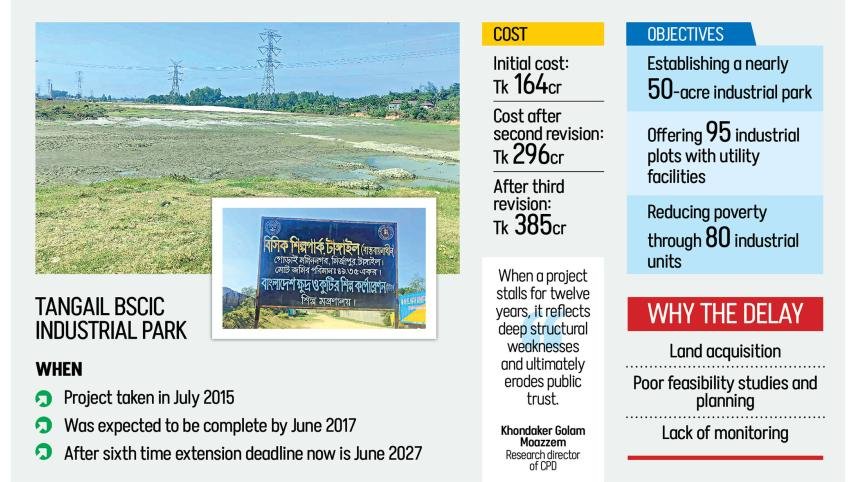


Nearly ten years ago, the Bangladesh Small and Cottage Industries Corporation (BSCIC) initiated a project to construct an industrial park in Mirzapur upazila of Tangail with the aim of generating employment opportunities through industrialization within two years and subsequently alleviating poverty.
After a decade, the industrial park remains incomplete, missing the initial two-year deadline six times and experiencing a cost increase of nearly 2.5 times its original budget.
BSCIC, the implementing agency, admitted to not conducting a feasibility study at the project’s onset in 2015, deeming it unnecessary then. Subsequently, it was discovered that the approximately 50-acre project site was not prepared for acquisition.
Following a prolonged acquisition process, it was determined that the land needed elevation above flood levels. Compounded by setbacks, the global shock of the Covid-19 pandemic and the economic repercussions of the Russia-Ukraine conflict further exacerbated poverty levels.
On November 10, the Executive Committee of the National Economic Council approved the project’s third revision, extending the completion deadline from June 2025 to June 2027, along with a cost increase of Tk 39.43 crore to Tk 385 crore.
Commencing in July 2015 with an initial budget of Tk 164 crore and an anticipated completion date of June 2017, the project aims to establish 80 industrial units and 95 industrial plots. Essential components include land acquisition, land development, plot construction, water supply infrastructure, a boundary wall, and administrative buildings as outlined in planning ministry documents.
Experts attribute the prolonged project timeline to deficient planning, inadequate land acquisition management, and a lack of accountability. Khondaker Golam Moazzem, research director at the Centre for Policy Dialogue (CPD), emphasized the necessity of comprehensive assessments such as pre-feasibility studies, market connections, and utility readiness, which are frequently overlooked.
Moazzem highlighted that political and bureaucratic influences often expedite projects without due diligence, resulting in prolonged land acquisition processes and substantial national losses in terms of potential employment opportunities and industrial growth.
Shaifuddin Khaled, an economics lecturer at Begum Rokeya University in Rangpur, condemned the project’s twelve-year delay as a structural planning failure, emphasizing the significant opportunity costs incurred. Khaled underscored the adverse impact of prolonged delays on employment prospects and economic growth within the region.
BSCIC’s project director, GM Rabbani Talukder, acknowledged the delays, attributing them primarily to land acquisition challenges. He disclosed the escalation of project costs due to the necessity of additional land filling to meet flood level requirements, a factor not initially accounted for in the project’s design.
Talukder mentioned the resolution of previous complications and expressed optimism that the project would be successfully completed within the extended deadline of June 2027, following stringent adherence to mandatory feasibility studies and professional assessments.