
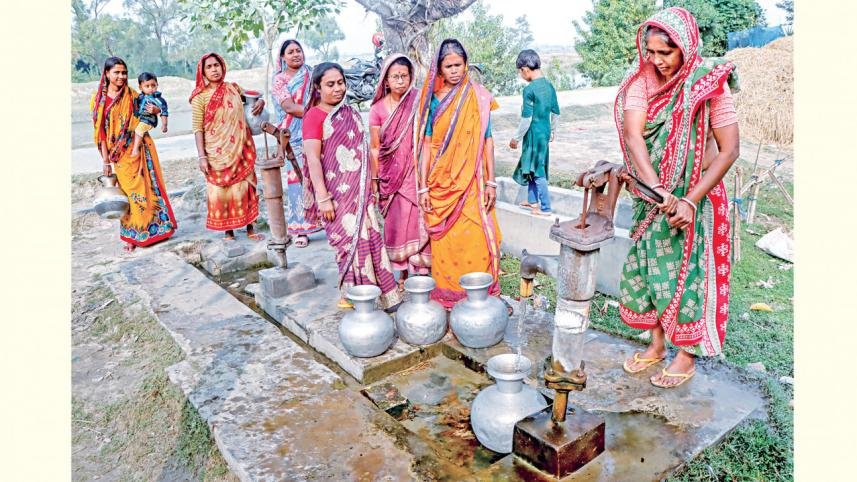


Water is crucial for sustaining life, yet in Bangladesh, the conversation around water security often focuses on issues like floods, salinity, and urban water scarcity, neglecting a key aspect: gender disparities. Women and girls bear a disproportionate burden in managing water for their households, but their needs and voices are often ignored in policy and planning.
Throughout the nation, women are predominantly responsible for the laborious and time-consuming task of collecting, storing, and overseeing household water. In many rural areas, women endure long journeys to fetch water, sometimes spending hours at crowded water sources. Research by Unicef reveals that globally, women and children spend a combined 200 million hours daily collecting water. In developing countries, they may dedicate up to six hours each day to this chore, covering nearly six kilometers on average. Even in regions with water pumps, women still spend considerable time collecting water due to waiting periods. This situation is mirrored in Bangladesh’s coastal villages and urban slums, where access to safe water remains unreliable and unequal.
During periods of drought, floods, or riverbank erosion, the time spent on water collection significantly rises. This increased effort often comes at the expense of girls’ education, women’s rest, or income opportunities. Apart from the physical toll, the constant worry of ensuring safe water for the family places an unseen psychological burden that is rarely reflected in official data.
The effects of climate change further exacerbate these inequalities. Unpredictable rainfall, escalating salinity levels, and recurrent floods have already disrupted freshwater sources across Bangladesh. Women are compelled to adapt by traveling longer distances, carrying heavier loads, and coordinating with neighbors and local authorities, all while managing their usual domestic duties.
Urban settings present a similar narrative. Cities like Dhaka and Chattogram grapple with severe water stress. Inconsistent supply, low pressure, and contamination force households to rely on tube wells, communal taps, or informal vendors. Even when piped water is available, women are still responsible for managing daily water usage within the household—cooking, cleaning, washing—while handling issues with landlords or municipal suppliers. When water becomes scarce or contaminated, women bear the immediate consequences and seek coping mechanisms.
The gendered aspect of water insecurity extends beyond household chores. Access to clean water influences education, health, and livelihoods. Inadequate sanitation facilities or conflicts between water collection and school hours often lead to girls missing classes. During menstruation, lack of water access and privacy exacerbates absenteeism and hygiene issues. Many women reduce or forego paid work to address household water needs, resulting in lost income and autonomy. Despite their pivotal role, women are underrepresented in decision-making processes, from community water user groups to national policy arenas.
While Bangladesh has made advancements in water access and climate resilience, many strategies treat water scarcity as a technical or environmental concern rather than a social issue. Gendered realities of water collection, storage, and management are often overlooked in policies. Without a deliberate focus on gender, these programs risk perpetuating the very disparities they seek to address.
Fortunately, there are successful examples of inclusive approaches. Initiatives like women-led water committees, gender-sensitive WASH programs, and participatory planning efforts have enhanced efficiency and sustainability. Communities where women play a role in water governance exhibit better maintenance of water systems and stronger hygiene practices. These initiatives underscore that empowering women in water management benefits entire communities.
To drive lasting change, gender equality must be integrated into all levels of water management, from infrastructure design to disaster readiness. This includes gathering sex-disaggregated data, conducting gender-responsive research, ensuring women’s representation in decision-making bodies, and promoting technologies that ease their workload. Acknowledging the unpaid labor women undertake in water management is crucial for designing equitable and efficient policies. Simple measures such as reducing the distance to safe water sources, ensuring privacy in sanitation facilities, or involving women in planning can significantly alleviate burdens while enhancing health and education outcomes.
Bangladesh’s path to water security hinges on closing the gender gap. Women are not passive victims of water scarcity; they are pivotal figures in water management and adaptation. Listening to their voices, addressing their needs, and recognizing their contributions will not only advance gender equality but also bolster national resilience against climate and environmental challenges. Hence, acknowledging and responding to the concealed gender inequality in water security is no longer a choice; it is imperative for fostering a more sustainable and equitable Bangladesh.