
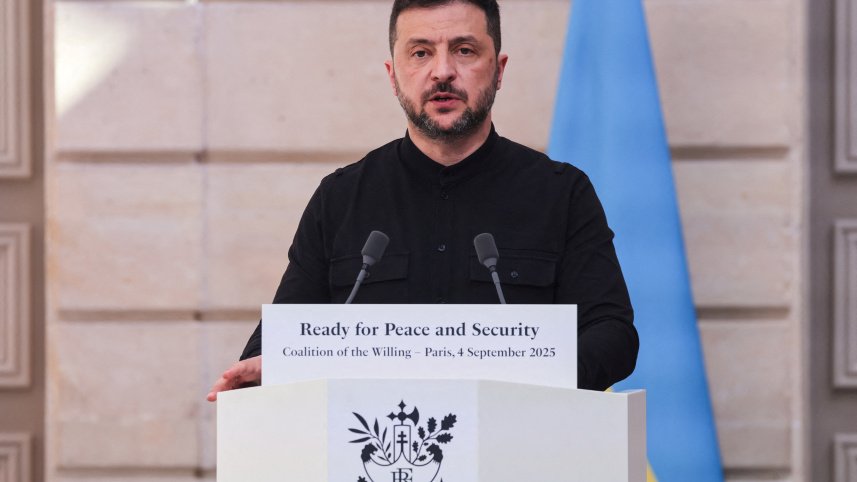


Twenty-six countries have committed to providing security assurances to Ukraine post-war, including the deployment of an international force across land, sea, and air, as announced by French President Emmanuel Macron following a summit meeting of Kyiv’s allies on Thursday. Macron revealed that a call was held with U.S. President Donald Trump to finalize American contributions to the guarantees in the upcoming days.
During the summit of the “coalition of the willing,” comprising mainly European nations, leaders aimed to finalize the security assurances and secure support from Trump to ensure the viability of such commitments. These security guarantees are aimed at reassuring Ukraine and deterring Russia, which previously initiated a full-scale invasion of Ukraine in 2022, from further aggression.
Macron emphasized that the security guarantees will be implemented once the conflict ceases, expressing a commitment to support Kyiv. European officials acknowledge that peace may be distant but are preparing for the post-war scenario. They view the planning of security assurances as a means to demonstrate solidarity with Kyiv and are hopeful for Trump’s engagement in their efforts.
While Macron initially suggested that the 26 nations would deploy to Ukraine, he later clarified that some countries would provide guarantees from outside Ukraine, potentially through training and equipping Ukrainian forces. The specifics of troop involvement in the guarantees were not disclosed.
Several countries, including Germany, expressed willingness to participate in the effort, contingent upon clarity on conditions and the extent of U.S. involvement in the security assurances. Italian Prime Minister Giorgia Meloni indicated a reluctance to send troops but offered support through ceasefire monitoring and training activities outside Ukraine.
France and Britain, co-chairs of the coalition of the willing, signaled openness to deploying troops to Ukraine post-war. Ukrainian President Zelenskiy confirmed the agreement of 26 countries to provide security guarantees, marking a significant step forward with concrete details.
Trump stressed the importance of European nations ceasing Russian oil purchases, which he claimed were financing Moscow’s military actions. The coalition, along with the U.S., agreed to collaborate on imposing sanctions, particularly targeting Russia’s energy sector and China’s involvement in supporting Russia’s actions.
Bulgaria stated it would not deploy troops to Ukraine but expressed readiness to contribute to naval operations in the Black Sea, such as de-mining efforts. Bulgaria also aspired to establish a regional security alliance with neighboring Romania and Turkey, focusing on maritime activities.
European leaders emphasized the necessity for European forces in Ukraine to have U.S. security guarantees as a safety net, although Trump’s commitment to this extent remains uncertain. Special envoy Steve Witkoff engaged in discussions with key diplomats before the summit to align positions and expectations.
The lack of progress in direct peace talks between Putin and Zelenskiy since Trump’s meeting with Putin in August was highlighted by European officials, urging Trump to increase pressure on Moscow. Putin expressed a preference for negotiations to end the conflict but did not rule out force if needed.
Despite Putin’s rejection of NATO troop deployment in Ukraine, NATO Secretary General Mark Rutte dismissed his objections, emphasizing Ukraine’s sovereignty and the need to prevent undue influence by Russia. Rutte underscored the importance of not empowering Putin excessively.